Google Me: How the Bucks Destroyed the Giannis Era in One Catastrophic Season
TL;DR
Milwaukee went 31-47, cost Giannis a Nike bonus, and watched Doc Rivers tell players to Google him. Now the franchise's greatest player wants out.
Thirty-six games.
That's how many times Giannis Antetokounmpo suited up for the Milwaukee Bucks this season. Thirty-six out of seventy-eight. A career low. A calf strain in December. A hyperextended knee in March. And when the most dominant physical specimen in basketball wanted to come back — wanted to play five more games to hit the 41-game threshold that would trigger a significant bonus in his Nike endorsement deal — the Bucks told him to sit down.
They were 31-47. Out of the playoffs for the first time since 2016. And they needed to protect their draft position.
So they protected their draft position. And they cost their franchise player millions.
The NBA is now investigating the situation. Let that sink in.
This is the story of how a championship organization imploded from the inside out in a single season.
It started before the losses. Before the injuries. Before the investigation. It started the moment the Bucks decided that waiving Damian Lillard — stretching $103 million across their cap — and replacing him with Myles Turner was the path forward. Lillard had torn his Achilles in the 2025 playoffs. He wasn't coming back this year. But the Bucks didn't just let him rehab. They cut him loose entirely. Stretched the money. Used the savings to sign Turner for $107 million.
Lillard went back to Portland. Signed a three-year, $42 million deal. The Blazers got their franchise legend back for less than half the price. The Bucks got a center and a tax bill. And a roster that would win 31 games.
Here's the part that makes it worse: when Giannis did play, he was still Giannis. In 36 games, he averaged 27.6 points, 9.8 rebounds, and 5.4 assists on 62.4% shooting. Those are MVP-caliber numbers. Those are numbers that should have a team in the playoffs. But the Bucks went 18-18 in the games he played, and 13-29 without him.
Thirteen and twenty-nine.
That's not a supporting cast. That's a cry for help.
And then came March 1st.
The Bucks had just been blown out by the Chicago Bulls. The locker room was a funeral. Doc Rivers — the man who'd been hired to turn this franchise around — called a team meeting before the next game against Boston.
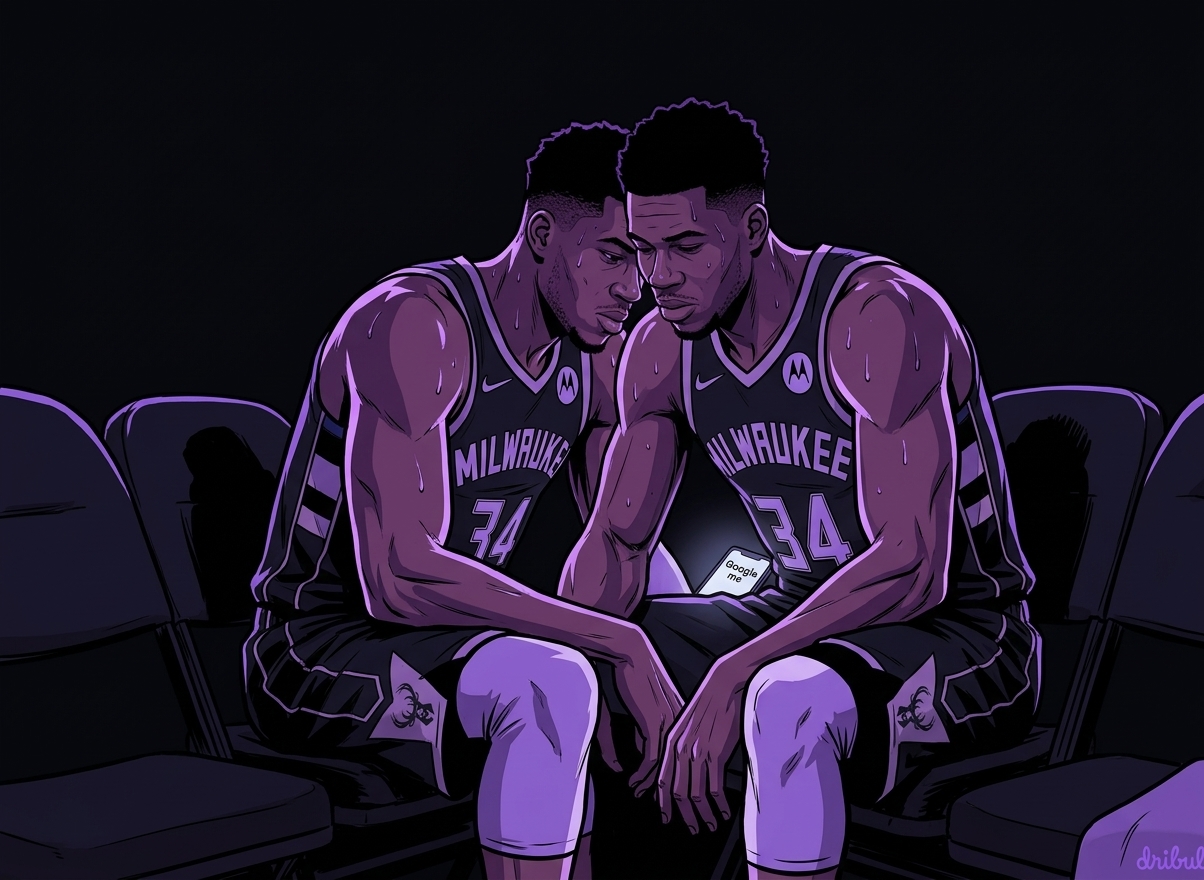
According to six people who were in the room, Rivers told his players: "Look at my resume. Google me. I took teams to the playoffs and championship that weren't supposed to be there."
Google me.
Two words that might end up on the tombstone of the Giannis era in Milwaukee. Because here's what happens when you actually Google Doc Rivers: you find a man who holds the NBA record for most blown 3-1 series leads. You find a coach who won one championship — in 2008, with a Big Three of Kevin Garnett, Paul Pierce, and Ray Allen — and has been coasting on it for 18 years. You find a career record that's respectable on paper and hollow in context.
Six people confirmed the comment was not well received. That might be the understatement of the decade.
The disconnect between Rivers and his players had been growing all season. A coach telling a locker room full of frustrated professionals to look up his accomplishments while they're sitting at 30-something wins isn't leadership. It's desperation. And everyone in that room knew it.
The irony? Two weeks after telling players to Google him, Rivers was elected to the Naismith Basketball Hall of Fame, Class of 2026. He'll be formally inducted in August. By then, he almost certainly won't be coaching the Bucks. Reports from Marc Stein indicate the franchise and Rivers are heading toward "some sort of parting or job restructuring." Rivers himself has hinted at retirement, telling reporters: "I have grandkids that I want to see."
But the coaching situation is just a symptom. The disease is deeper.
Sources close to the team have described the environment as "as toxic of a team situation as any in the league." One source added: "They waited until the very end on Giannis, and now everyone knows."
Everyone knows what? That the Bucks are open to trading the greatest player in franchise history.
Giannis himself confirmed that the Bucks and New York Knicks discussed a trade during last offseason. At the February trade deadline, the Miami Heat offered Tyler Herro, Kel'el Ware, and multiple draft assets. The Bucks turned it down — not because they wanted to keep Giannis, but because they believed they'd get better offers this summer.
Read that again. They didn't reject the trade out of loyalty. They rejected it for leverage.
Antetokounmpo's contract runs through 2026-27. He can opt for free agency in the summer of 2027. The clock isn't just ticking — it's screaming. And the Bucks know that every month of dysfunction chips away at their return.
The Warriors are circling. The Knicks are salivating. Miami is waiting by the phone. The bidding war for a 31-year-old generational talent is about to begin, and Milwaukee is going to be on the selling end of the most painful trade in franchise history.
Think about the arc of this. In 2021, Giannis hit a game-sealing alley-oop in Game 6 of the Finals, dropped 50 points, and delivered Milwaukee its first championship in 50 years. He signed a supermax extension. He was supposed to be a Buck for life. The next LeBron who actually stayed.
Four years later, his coach is telling players to Google him after blowout losses, the organization is costing him endorsement money by benching him on a tanking team, the NBA is investigating whether the whole thing was coordinated, and every major franchise in the league is drawing up trade packages.
From championship parade to NBA investigation in four seasons. From "Bucks in Six" to 31-47.
Milwaukee didn't just lose this season. They didn't just miss the playoffs. They didn't just waste a year of Giannis. They systematically dismantled every reason he had to stay. The roster around him deteriorated. The coaching became a punchline. The front office chose draft positioning over their star's financial interests. And when it all fell apart, they started shopping him for parts.
Giannis Antetokounmpo averaged 27.6 points on 62.4% shooting at age 31. He was still a top-ten player in the NBA. He could still carry a team to the playoffs — if the team around him was worth carrying.
The Bucks decided it wasn't worth finding out.
Google that.
Keep Reading
The WNBA Just Raised Foul Fines 2.5x. Everyone Calls It the Caitlin Clark Tax.
6 min read
WNBA GMs Just Took Caitlin Clark's Franchise Crown. The Tiebreaker Was a Groin Injury.
5 min read

Lauren Betts Is 6'7", Won a National Title, and Just Outplayed Angel Reese in Preseason. Washington Has a Problem on Their Hands — a Good One.
6 min read