The NBA Spent Years Telling You to Gamble. Then Its Own Players Got Caught.
TL;DR
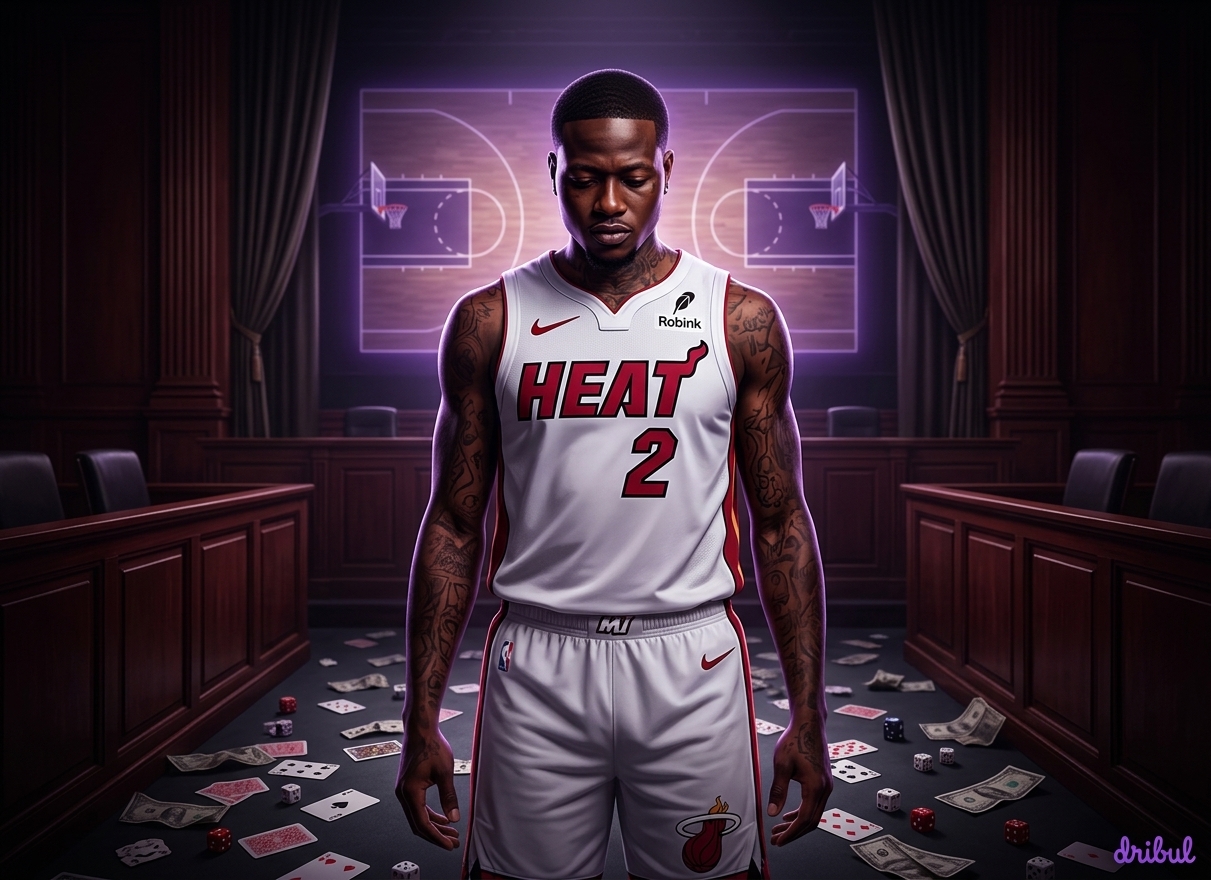
Terry Rozier tipped off bettors before leaving a game after 9 minutes. Chauncey Billups was a celebrity lure for mafia-rigged poker. 34 people arrested. And the league still has DraftKings and FanDuel logos on every broadcast.
On March 23, 2023, Terry Rozier suited up for the Charlotte Hornets against the New Orleans Pelicans. He played nine minutes and 34 seconds. Five points, four rebounds, two assists. Then he left the game with "right foot discomfort."
Nothing weird about that. Players leave games early all the time. Except sportsbooks noticed something before tipoff: an avalanche of bets on Rozier's unders. So many that some books just stopped taking Rozier props entirely that night.
Here's what the FBI says happened: Rozier told his childhood friend Deniro Laster he was going to leave the game early. Laster sold that information to known bettors for approximately $100,000. Those bettors then placed over $200,000 in wagers predicting Rozier would underperform. He left after nine minutes. They cashed out.
Rozier made $21.8 million that season.
On October 23, 2025 — two and a half years after that Pelicans game — the FBI arrested 34 people in two separate indictments connected to NBA gambling. Terry Rozier. Chauncey Billups. Former player Damon Jones. Members of the Bonanno, Genovese, and Gambino crime families. All in one sweep.
I want you to read that sentence again. The Bonanno, Genovese, and Gambino crime families. This isn't a player betting on a few parlays. This is the actual mob.
The Two Schemes
The FBI uncovered two separate operations running simultaneously.
The first was the sports betting scheme — Rozier's world. Federal prosecutors identified at least seven NBA games between February 2023 and March 2024 where non-public information was used to manipulate bets. The Rozier-Pelicans game was the marquee example, but investigators believe it was part of a much larger pattern. Players tipping off associates about injuries, minutes restrictions, or lineup changes before sportsbooks could adjust their lines.
The second was somehow worse. Billups — a Hall of Famer, the head coach of the Portland Trail Blazers, a guy who won a Finals MVP — was allegedly the celebrity "face card" for a network of rigged high-stakes poker games. Prosecutors say organizers used sophisticated technology: modified shuffling machines, special contact lenses, and (I am not making this up) an X-ray table that could read card faces through the felt. Players were cheated out of approximately $7 million.
During one game, organizers allegedly texted each other that a victim "acted like he wanted Chauncey to have his money" because he was "star struck." Billups reportedly received a $50,000 wire transfer after a single rigged game in October 2020.
He was arrested in Portland one day after the Trail Blazers' season opener. Released on a $5 million bond secured by his family's home in Colorado. Pleaded not guilty. Placed on unpaid leave. Tiago Splitter is coaching Portland now.
The Heat Cut Rozier Loose
After his arrest, the NBA placed Rozier on immediate leave. He lost $1,110,126 per paycheck — 24 installments over the season. His 2025-26 salary was $26.6 million. Was.
In his limited time on the court this season, Rozier averaged 13.9 points, 3.9 rebounds, and 3.5 assists. Decent numbers for a guy whose career was imploding in slow motion.
An arbitrator ruled the NBA couldn't withhold his salary — players can only be suspended without pay in cases of domestic or child abuse. So Rozier's checks started flowing again. But the Heat had seen enough. On April 9, 2026 — yesterday — Miami officially waived Terry Rozier before the playoff roster deadline. His contract was expiring. They let it die.
This is a guy who averaged 23.2 points per game in Charlotte before the trade. Career highs across the board. The Heat gave up Kyle Lowry and a first-round pick to get him. Now he's looking for a lawyer, not a team.
The Part Nobody Wants to Talk About
Here's where I get genuinely frustrated.
The NBA has 17 authorized gaming operators. DraftKings and FanDuel are "official" sports betting partners. Every broadcast has a sportsbook segment. Every arena has a betting lounge. The league changed its rules in recent years to let players endorse and invest in sportsbooks.
And then — in January 2026, two months after 34 people got arrested for fixing NBA bets — the league signed a multi-year partnership with PrizePicks. A daily fantasy sports company. Whose flagship product is player prop pick'em games.
Player props. The exact product category that the Rozier scheme exploited. The FBI literally described how insiders used player performance information to rig player prop bets, and the NBA responded by partnering with a company that makes player prop games.
I'm not saying PrizePicks did anything wrong. I'm saying the league created an ecosystem where gambling is everywhere, then acted shocked when its players became part of the supply chain.
The Senate Commerce Committee has demanded answers. Cornell Law School published a paper titled "NBA Sports Betting and Gambling Getting Out of Hand." The league tightened injury-reporting timelines and worked with regulators to reduce the variety of player prop bets available. Good steps. But the money kept flowing.
This Has Happened Before
Tim Donaghy refereed NBA games for 13 years. He bet on games he officiated. He fed inside information to gamblers connected to the Gambino crime family — the same family name that showed up in the 2025 indictments. Donaghy went to prison in 2008. The NBA called him a rogue actor. Commissioner David Stern said it was an "isolated case."
It wasn't isolated. It was a preview.
The difference now is scale. In 2007, it was one referee. In 2025, it's 34 people, multiple active players, a Hall of Fame coach, and three organized crime families. The infrastructure for corruption didn't shrink after Donaghy — it grew, because the money grew.
Legal sports betting in the United States generated over $120 billion in handle in 2025. The NBA gets a cut. The teams get a cut. The broadcast partners get a cut. And somewhere in that chain, a few players realized they had information worth selling.
What Happens Now
Rozier's attorneys are trying to get the charges dismissed. They argue the government overreached — that wire fraud statutes weren't designed for this. Judge LaShann DeArcy Hall will hear oral arguments on April 27 in Brooklyn. Billups is fighting his charges too. Both have pleaded not guilty.
Rozier is 32 years old. Even if he beats the charges, no team is touching him this summer. Billups may never coach again. Damon Jones's name is mud. And the 31 other defendants — the fixers, the middlemen, the organized crime associates — are looking at up to 20 years each.
Meanwhile, the NBA playoffs start April 18. DraftKings will have a pregame segment. FanDuel will run a promo. The PrizePicks partnership will be in full swing. And nobody on the broadcast will mention that two months ago, the league's own people were running the exact kind of scheme that makes all of it possible.
The NBA didn't create gambling. But it built the stadium around it, sold tickets, and then acted surprised when someone started a fire.
Keep Reading
The WNBA Just Raised Foul Fines 2.5x. Everyone Calls It the Caitlin Clark Tax.
6 min read
WNBA GMs Just Took Caitlin Clark's Franchise Crown. The Tiebreaker Was a Groin Injury.
5 min read
Lauren Betts Is 6'7", Won a National Title, and Just Outplayed Angel Reese in Preseason. Washington Has a Problem on Their Hands — a Good One.
6 min read