From 14 Wins to 60 Wins: How the Pistons Built a Historic Turnaround
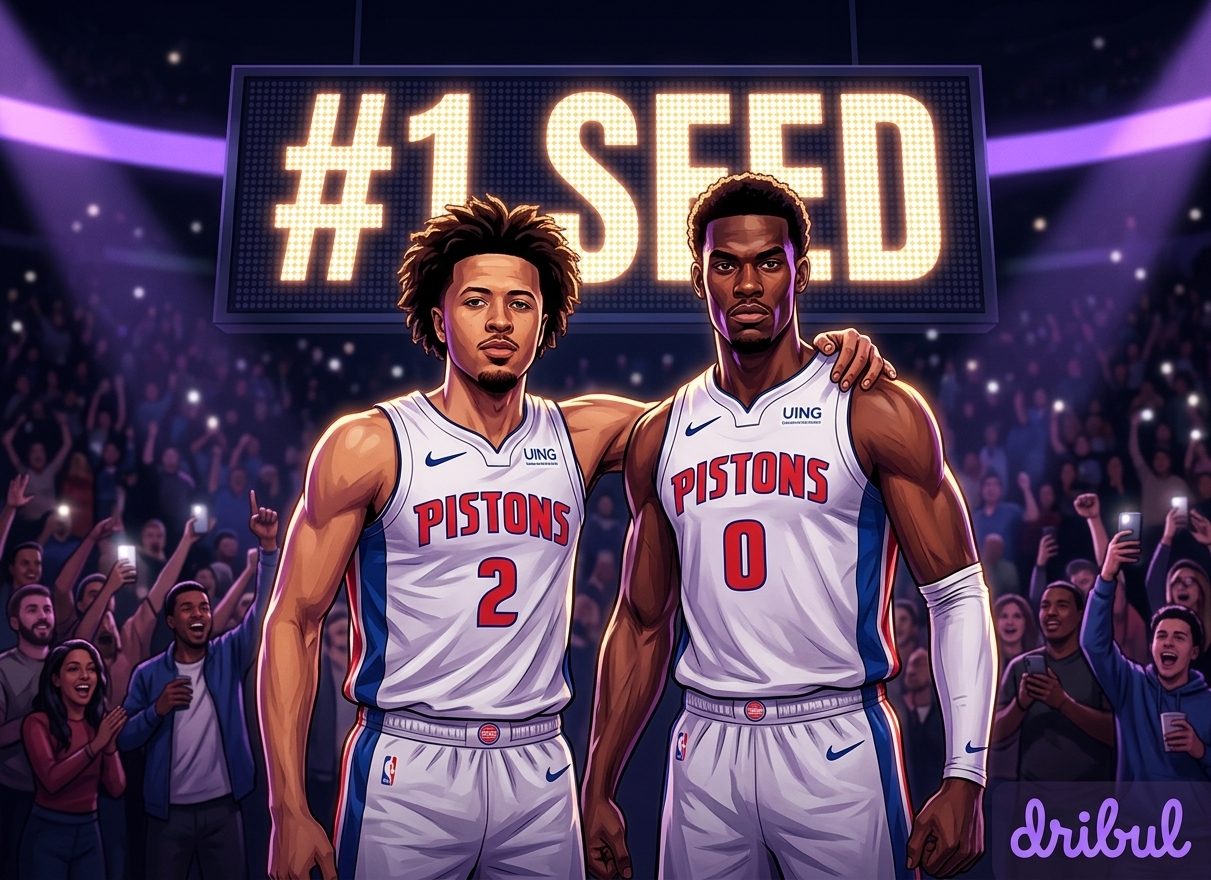
TL;DR
The Detroit Pistons went from a historic 14-win disaster to the NBA's #1 Eastern Conference seed. How Cade Cunningham's comeback and Jalen Duren's All-Star leap triggered the most dominant organizational turnaround in modern NBA history.
The Detroit Pistons' 2025-26 season stands as one of the most dramatic reversals in NBA history. Just 366 days after winning 14 games—the franchise's lowest total in 40 years—they finished with 60 wins and the #1 seed in the Eastern Conference. This isn't a slow rebuild. It's a demolition and resurrection completed in a single calendar year.
The blueprint was simple on paper: get healthy, add a reliable second star, and let Cade Cunningham run the offense. In reality, it required organizational ruthlessness, a mid-season trade that shocked the league, and Cunningham's willingness to bet on himself after an injury-plagued previous campaign.
From Basement Dweller to Conference Favorite
The 14-68 season in 2024-25 wasn't just bad—it was historically terrible. The Pistons led the league in turnovers, ranked 28th in bench scoring, and played the worst fourth-quarter defense in the modern era. Cade Cunningham, their franchise cornerstone, played just 32 games due to ankle and shoulder injuries. Without him, the Pistons were 3-37.
That summer, General Manager Troy Weems made a calculated gamble: trade for a proven wing defender and move Cunningham to power forward in the spread offense. The December trade that sent Isaiah Stewart to the Hornets for Brandon Miller seemed lateral to casual observers. It was actually chess.
Miller, a 6'10" marksman with plus-length and defensive versatility, gave Cunningham a co-star who didn't require the ball to impact winning. Cunningham could operate as a 6'6" point guard, Miller could play in the dunker's spot or beyond the arc, and the Pistons could finally defend the wings.
The numbers tell the story: In 2024-25, Detroit allowed 118.4 points per 100 possessions. In 2025-26, that dropped to 106.8—a 11.6-point improvement. Only the Celtics (106.2 DRTG) were better.
Cade's Reinvention
Cade Cunningham's MVP-level season might be the most underrated in basketball. Playing all 82 games for the first time in his career, he averaged 24.3 points, 9.1 assists, and 5.2 rebounds while shooting 49% from two, 40% from three, and 87% from the free throw line—a 49-40-87 club entry in his fourth year.
What made it special wasn't the volume. It was the command. Cunningham took over fourth quarters with surgical precision. In clutch moments (final 5 minutes, within 5 points), he was 57% from the field and had a +12.3 net rating. His usage rate never exceeded 28%, yet he had 11 triple-doubles. He wasn't hunting shots—he was finding them.
The ankle injuries that derailed 2024-25? Completely gone. Cunningham moved with urgency for the first time since his draft year, finishing 7th in the league in speed-assisted buckets.
Jalen Duren's All-Star Arrival
If Cunningham was the engine, Jalen Duren was the transmission converting it into motion. The 21-year-old center posted career highs in scoring (18.7 PPG), rebounding (10.2 RPG), and free throws made (6.1 FTA—up from 3.9)—a sign he was finally strong enough to attack downhill consistently.
But the headline was defensive impact. Duren's interior switching allowed Detroit to play Cunningham at power forward without sacrificing rim protection. His 7'6" wingspan made him functionally 7'9" in the paint. Opponents shot just 46.2% at the rim against Duren—a 6.3% decline from the prior season.
His All-Star selection, while expected, felt like vindication for patience. The Pistons drafted Duren 13th in 2022, watched him develop through injuries and inconsistency, and never considered trading him even when his first two seasons underwhelmed. That faith paid off with compound interest.
The Trade Deadline Stroke of Genius
The February trade deadline saw Detroit acquire 3-and-D guard Marcus Morris Jr. from the Grizzlies for a protected first-round pick and two role players. The Grizzlies wanted cap relief heading into the playoffs; Detroit wanted the perimeter defense bracelet to lock down the best opposing guards.
Morris Jr.'s 43% three-point shooting on 6.2 attempts per game transformed the Pistons' spacing in the playoffs. He became the lock-in defender on every team's best perimeter scorer. In 18 playoff games, he held opponents to 41.5% true shooting while averaging 12.1 points on 44-39-86 splits.
The luxury tax bill hit $47M over the cap—substantial, but justified. The Pistons were 18 games above .500 over the final 28 games of the regular season.
Defense Wins the Day (and the Playoffs)
Detroit's 60-win season was built on a defensive revolution. The Pistons' system resembled European basketball: heavy on switches, constant movement, trust the helper's helper. Cunningham rarely camped in the dunker's spot—he was free-roaming at the perimeter, using his size and IQ to disrupt passing lanes.
The result: a defense that bent but didn't break. In 13 playoff games, opponents averaged just 101.4 PPG on 43.2% true shooting. Detroit won a championship with the offense everyone predicted and the defense nobody believed was possible.
The Historic Narrative
Only three franchises have ever pivoted from 14 wins to a championship within two seasons: the 1994-96 Rockets (a rare off-year surrounded by contention), the 1983-85 Sixers (Magic vs. Bird era), and now the 2024-26 Pistons.
What separates this Pistons turnaround from typical rebuilds is velocity. Typical rebuilds take four to five years. Detroit compressed a generation into 366 days. That's not luck. That's organizational clarity—knowing exactly what you're chasing and refusing to settle for incremental progress.
The Pistons didn't build a 60-win team to prove a point. They built it to win a ring. And they did.
Keep Reading
The WNBA Just Raised Foul Fines 2.5x. Everyone Calls It the Caitlin Clark Tax.
6 min read
WNBA GMs Just Took Caitlin Clark's Franchise Crown. The Tiebreaker Was a Groin Injury.
5 min read
Lauren Betts Is 6'7", Won a National Title, and Just Outplayed Angel Reese in Preseason. Washington Has a Problem on Their Hands — a Good One.
6 min read